
Paddling out through heavy whitewater, popping up on a steep takeoff, and twisting through a cutback all demand a body that can move freely under load. Most surfers, however, treat flexibility like an afterthought—until a tweaked lower back or a stiff shoulder forces them to sit out a swell. The truth is that a structured surfing exercise program needs to include targeted mobility work just as much as it needs paddling and pop-up drills. This article breaks down exactly which yoga and stretching routines protect your joints, how to speed up recovery after long sessions, and when flexibility training can actually do more harm than good.
Quick Answer
A surf-specific yoga and stretching routine should prioritize hip mobility, thoracic spine rotation, shoulder stability, and hamstring flexibility—the areas most stressed by paddling and maneuvering. Use dynamic stretches before surfing, static holds and yoga flows after sessions or on rest days, and allow 24–48 hours between intense flexibility work on the same muscle groups. Consistency two to three times per week produces better injury prevention than occasional long sessions.
Key Takeaways
- Surfing creates a predictable pattern of tight hips, locked thoracic spines, and overworked shoulders—flexibility work should target these specific imbalances rather than general stretching.
- Dynamic mobility belongs before a session; static stretching and longer yoga holds belong after or on rest days.
- Passive flexibility without stability training can increase injury risk, so pair stretching with activation exercises.
- Recovery speed depends as much on sleep, hydration, and load management as it does on stretching itself.
- Warm-water surfers and cold-water surfers may need different routines based on wetsuit restriction and water temperature.
Why Surfers Get Injured in Predictable Ways
Surfing is asymmetrical. You paddle with your chest pressed into a board, your spine extended, your shoulders internally rotated, and your hips locked in one position for long stretches. Then you explode into a pop-up that demands hip flexion, spinal rotation, and shoulder extension—often without any warm-up. Over time, this pattern shortens hip flexors, weakens glutes, tightens lats, and reduces thoracic rotation.
Most non-impact surfing injuries—lower back strain, shoulder impingement, knee tweaks, and neck stiffness—stem from these imbalances rather than from a single traumatic event. A yoga and stretching routine that addresses them directly is far more useful than a generic flexibility class.
The four problem areas
- Hips: Prolonged prone paddling and sitting on boards tighten hip flexors and adductors.
- Thoracic spine: Limited rotation forces the lower back to compensate during turns.
- Shoulders: Repeated paddling builds internal rotation dominance and can narrow the subacromial space.
- Hamstrings and calves: Pop-ups require rapid lengthening under load; tight posterior chain tissue increases strain risk.
Pre-Surf Mobility: What to Do Before You Paddle Out
Before surfing, you want to raise tissue temperature and take joints through their available range—not force new range. Static stretching before a session can temporarily reduce power output and does little to prevent injury. Save the long holds for later.
A five-minute pre-surf flow
- Cat-cow (10 reps): Moves the spine through flexion and extension, waking up the erectors and abdominals.
- World’s greatest stretch (5 per side): Combines a lunge, thoracic rotation, and hamstring lengthening in one movement.
- Arm circles and shoulder dislocates with a band or towel (10 reps): Prepares the shoulder capsule for paddling.
- Leg swings front-to-back and side-to-side (10 per leg): Opens the hips dynamically.
- Bodyweight squats with a pause (8 reps): Primes the pop-up pattern.
If the water is cold and you’re wearing a thick wetsuit, add an extra two minutes of movement. Restricted rubber limits your range before you even touch the water.
Post-Surf Stretching and Yoga for Recovery
After a session, tissues are warm and pliable—this is the ideal window for static stretching and longer yoga holds. The goal here is to restore length to tissues that spent hours in a shortened position and to downshift your nervous system.
Targeted post-surf sequence
- Low lunge with side bend (60–90 seconds per side): Lengthens hip flexors and the lateral chain.
- Pigeon pose or figure-four stretch (90 seconds per side): Targets glutes and piriformis, which tighten from prone positioning.
- Thoracic rotation in a side-lying position (10 slow reps per side): Restores the rotation lost to paddling.
- Doorway or wall chest stretch (60 seconds per side): Counters internal rotation dominance.
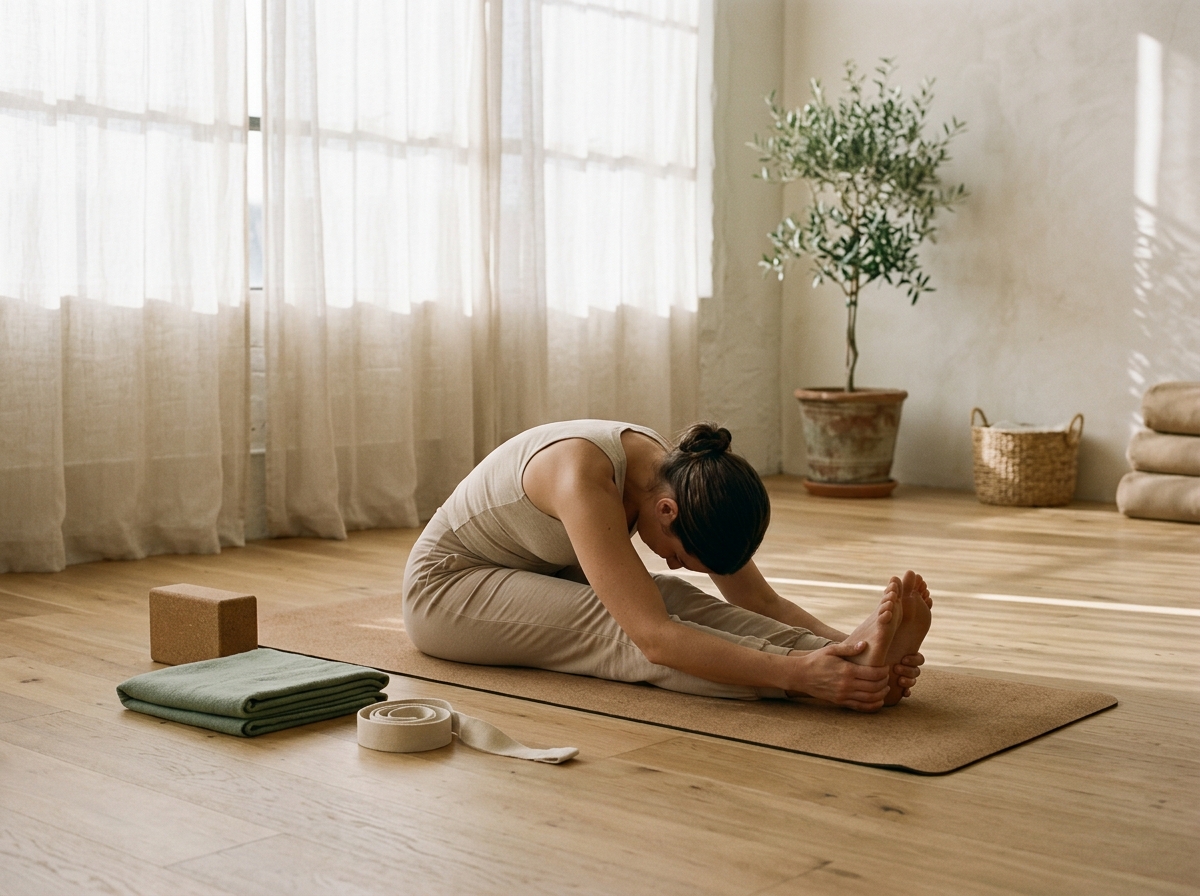
- Seated forward fold (90 seconds): Gently lengthens hamstrings and calves.
- Legs-up-the-wall (3–5 minutes): A restorative pose that supports venous return and parasympathetic recovery.
A short post-surf yoga flow
If you prefer a flowing practice, a 15-minute sequence of downward dog, low lunge, triangle, seated twist, and savasana covers the same ground. Keep the pace slow and breathe through the nose. The point is recovery, not performance.
Which Yoga Styles Actually Help Surfers
Not all yoga translates equally to surfing. Some styles build the mobility and body awareness that support wave riding; others emphasize positions that don’t map onto surf demands.
| Style | Best For | Limitations for Surfers |
|---|---|---|
| Vinyasa | Building flow, breath control, general mobility | Can be too fast for tight shoulders if not modified |
| Yin | Deep connective-tissue release on rest days | Long holds may be too much before a session |
| Hatha | Learning alignment and foundational poses | Less cardiovascular carryover |
| Ashtanga | Strength, discipline, upper-body endurance | Repetitive sequences may aggravate existing shoulder issues |
| Restorative | Nervous system recovery after heavy surf blocks | Minimal mobility gain; best used sparingly |
For most surfers, a mix of vinyasa for mobility and yin or restorative for recovery covers the bases. Ashtanga can work well if you’re already strong and pain-free.
How Often Should You Stretch?
Two to three dedicated sessions per week is enough for most surfers to see meaningful changes in range of motion. Daily short sessions—10 to 15 minutes—often work better than one long weekend class because consistency matters more than duration.
If you’re recovering from an injury, frequency should be guided by a physiotherapist or sports medicine professional. More stretching is not automatically better, and aggressive stretching of an acutely injured tissue can delay healing.
When to back off
- Sharp pain during a stretch—stop immediately.
- Numbness or tingling in the limbs—this suggests nerve involvement, not muscle tightness.
- Increased pain the day after stretching—reduce intensity or duration.
- Feeling unstable or “loose” in a joint—shift focus to stability work instead.
Stretching Alone Isn’t Enough: The Stability Connection
Flexibility without control is a liability. A shoulder that can rotate freely but lacks rotator cuff strength is more likely to sublux or impinge. A hip that has range but no glute activation will compensate through the lower back.
For every major stretch, consider pairing it with an activation exercise. After a hip flexor stretch, do glute bridges. After a chest stretch, do band pull-aparts. After a hamstring stretch, do single-leg Romanian deadlifts. This combination—lengthen then strengthen—is what actually reduces injury risk.
Recovery Beyond the Mat
Stretching supports recovery, but it isn’t the whole picture. Sleep, protein intake, hydration, and managing total surf volume all play larger roles than most surfers admit. If you’re surfing twice a day, every day, no amount of pigeon pose will prevent overuse injuries.
Practical recovery levers include:
- 7–9 hours of sleep per night.
- Adequate protein (roughly 1.6–2.2 g per kg of bodyweight for active individuals).
- At least one full rest day per week during heavy swell cycles.
- Alternating high-intensity sessions with easier ones.
- Hydration and electrolytes, especially in tropical climates.
Frequently Asked Questions
How long does it take to see flexibility improvements?
Most people notice modest range-of-motion gains within two to four weeks of consistent practice. Significant, lasting changes typically take eight to twelve weeks. Progress is faster when stretching is paired with strength work and adequate recovery.
Can yoga replace a surf-specific training program?
No. Yoga builds mobility, body awareness, and some strength, but it doesn’t replicate paddling endurance, pop-up speed, or breath-hold capacity under turbulence. It works best as a complement to a broader conditioning plan.
Is it bad to stretch before surfing?
Long static holds before surfing can temporarily reduce power and don’t reliably prevent injury. Dynamic mobility—leg swings, rotations, controlled squats—is a better pre-surf choice. Save static stretching for after your session.
What’s the single most important stretch for surfers?
If forced to pick one, a hip flexor stretch with a side bend addresses the most common restriction caused by prone paddling. That said, no single stretch covers the shoulders, thoracic spine, and hamstrings that also need attention.
Should I stretch if I’m already injured?
It depends on the injury. Mild muscular tightness often responds well to gentle movement, but acute strains, joint injuries, and nerve symptoms should be assessed by a medical professional before any stretching. Stretching an injured tissue incorrectly can prolong recovery.
How do I know if I’m overstretching?
Stretching should feel like a mild to moderate pull, never sharp pain. If you feel burning, tingling, or joint pain, you’ve gone too far. Persistent soreness lasting more than a day after stretching is a sign to ease off.
Conclusion
Injury prevention and faster recovery come down to matching your routine to how surfing actually loads your body. Prioritize hip flexors, thoracic rotation, shoulders, and hamstrings. Use dynamic mobility before sessions and static stretching or yoga afterward. Pair every stretch with stability work, and treat sleep, nutrition, and session volume as part of your recovery plan—not extras. Two to three short, consistent sessions per week will do more for your surfing longevity than any single long class.