
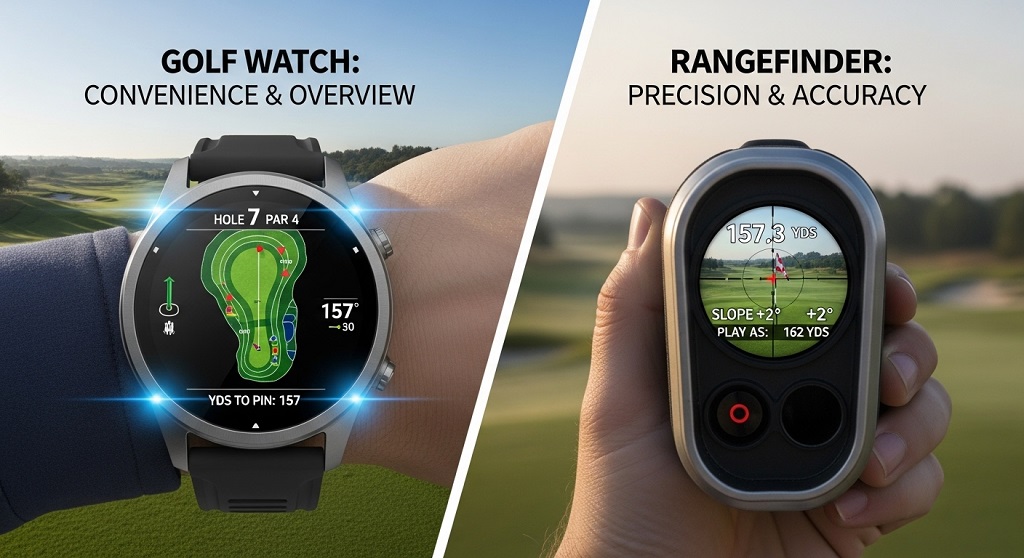
Golf watches with GPS help players make smarter decisions on the course by providing accurate yardages, hazard distances, and shot planning support in real time. Instead of guessing club selection or relying on course markers, golfers can see precise front, middle, and back green distances directly on their wrist. This improves confidence, reduces mistakes, and supports better course management.
Many golfers lose strokes not because of poor swings but because of poor decisions. Choosing the wrong club. Aiming at risky pins. Misjudging hazard distance. These errors add up quickly. GPS golf watches solve this problem by turning guesswork into strategy.
According to shot-tracking data from amateur performance studies using GPS-enabled wearables, players who rely on consistent yardage data reduce approach-shot dispersion and improve greens-in-regulation percentages over time. That translates directly into lower scores.
This guide explains how to use golf watches with GPS step by step to improve course strategy, avoid common decision mistakes, and play smarter across every hole.
What Are Golf Watches With GPS and How Do They Improve Course Strategy?
Short answer: Golf watches with GPS improve course strategy by providing precise yardages, hazard locations, and shot-planning insights that help golfers choose safer and more effective targets.
Traditional course management depends on visual estimates and sprinkler-head markers. These methods are inconsistent. GPS watches replace estimation with reliable distance data.
Most modern GPS golf watches provide:
- Distance to front, middle, and back of green
- Hazard carry distances
- Layup distances
- Dogleg positioning
- Shot tracking data
- Digital scorecards
Instead of asking, “How far is the pin?” golfers can ask better questions:
- Where is the safest landing zone?
- Which club avoids the bunker?
- Should I attack or play conservative?
This shift from distance guessing to decision-making is what improves scoring.
Why Do Amateur Golfers Lose Strokes Without GPS Distance Data?
Short answer: Amateur golfers lose strokes mainly because they misjudge yardage, choose incorrect clubs, and underestimate hazards.
A large percentage of missed greens come from incorrect distance estimation rather than swing errors.
Typical mistakes include:
- Overestimating carry distance
- Aiming directly at dangerous pin locations
- Ignoring wind-adjusted yardage
- Misjudging elevation change
- Selecting aggressive targets unnecessarily
Shot tracking platforms consistently show that distance control is one of the biggest scoring differences between mid-handicap and low-handicap players.
Golf watches with GPS reduce these mistakes by providing objective numbers instead of assumptions.
How Do Golf Watches With GPS Help You Choose the Right Club?
6
Short answer: GPS golf watches help select the right club by showing exact yardage to key targets rather than estimated distances.
Club selection errors often come from choosing based on pin distance alone. Smart players instead select clubs based on safe landing zones.
Example scenario:
| Situation | Without GPS Watch | With GPS Watch |
|---|---|---|
| Approach shot 150 yards | Aim at flag directly | See bunker starts at 142 yards |
| Decision | Risk bunker | Choose safer 7-iron target |
| Outcome | Possible hazard penalty | Safer green landing |
That single decision can save one stroke per hole across multiple rounds.
How Can GPS Watches Help You Avoid Hazards More Effectively?
Short answer: GPS watches prevent hazard mistakes by displaying carry distances to bunkers, water, and rough zones before each shot.
Hazards are responsible for many penalty strokes in amateur play.
GPS watches reduce these penalties by showing:
- Distance to front of bunker
- Distance to back of bunker
- Water carry yardage
- Safe layup distance
Instead of reacting after landing in trouble, golfers plan around hazards before swinging.
This shifts play from reactive to proactive.
How Do Golf Watches With GPS Improve Tee Shot Strategy?
Short answer: GPS golf watches improve tee shot planning by identifying optimal landing zones rather than simply encouraging maximum distance.
Many golfers automatically reach for a driver. That decision often ignores hole layout risks.
A GPS watch helps answer smarter questions:
- Where does the fairway narrow?
- Where does the dogleg begin?
- What distance avoids fairway bunkers?
Example strategy shift:
Instead of hitting driver 240 yards into trouble, a player chooses hybrid to 200 yards into the center fairway.
Fairway position improves the next shot. Approach accuracy improves. Scoring improves.
Can GPS Watches Help You Plan Safer Approach Shots?
Short answer: Yes. GPS watches help golfers aim toward safe green zones instead of risky pin placements.
Pin placement varies daily. Attacking every flag increases missed greens.
Smart golfers instead aim toward:
- Center of green
- Wide landing zones
- Safe miss areas
GPS watches show front-middle-back yardages instantly. That makes center-green targeting easier.
Over time, this increases greens in regulation percentage.
How Do Golf Watches With GPS Support Smarter Layup Decisions?
Short answer: GPS watches help players choose exact layup distances that create easier next shots.
Layups are strategic positioning tools.
Instead of guessing where to stop the ball, GPS watches allow golfers to:
- Lay up short of hazards
- Avoid awkward wedge distances
- Create preferred approach yardages
Example:
A player avoids stopping at 40 yards and instead lays up to 95 yards, their strongest wedge distance.
This increases scoring opportunities immediately.
Do GPS Golf Watches Improve Confidence on the Course?
Short answer: Yes. Accurate yardage reduces hesitation and improves commitment before each swing.
Confidence affects execution.
Uncertainty creates swing tension. Clear yardage reduces mental noise.
Golf watches with GPS support confident decisions by providing:
- Reliable numbers
- Consistent feedback
- Faster decision-making
- Reduced second-guessing
Players swing better when decisions feel certain.
How Can Shot Tracking Features Improve Long-Term Course Strategy?
Short answer: Shot tracking reveals performance patterns that help golfers adjust strategy based on real data instead of perception.
Many golfers misjudge their strengths.
Shot tracking tools built into modern GPS watches record:
- Average club distance
- Accuracy patterns
- Miss tendencies
- Approach dispersion
Example insight:
A player believes their 7-iron travels 160 yards but tracking shows average carry is 148 yards.
Adjusting expectations prevents short approaches across multiple holes.
What Role Do GPS Green Maps Play in Better Putting Strategy?
Short answer: Green-view features help golfers understand depth and positioning before selecting approach targets.
Knowing green shape changes approach planning.
GPS watches often display:
- Green depth
- Front entry angle
- Back slope risk
- Side hazard proximity
Instead of aiming blindly, golfers choose landing zones based on green structure.
This reduces three-putts over time.
How Should Beginners Use Golf Watches With GPS During a Round?
Short answer: Beginners should check distances before every shot and aim for safe landing zones instead of flags.
Simple beginner workflow:
- Check yardage before tee shot
- Avoid hazards using carry distances
- Aim center green on approaches
- Select clubs based on total distance
- Track score digitally
This routine builds structured decision-making habits quickly.
Are Golf Watches With GPS Allowed in Tournament Play?
Short answer: Yes. Distance-measuring devices are allowed under most rules when slope features are disabled.
Rule allowances vary by event type.
Typical permitted functions:
- Distance measurement
- Hole layout viewing
- Hazard positioning
Usually restricted:
- Slope-adjusted yardage
- Wind-adjusted recommendations
- Club suggestions during competition
Always confirm local rules before tournament play.
Conclusion: How Can You Start Using Golf Watches With GPS More Strategically Today?
Golf watches with GPS transform how players approach course management. Instead of reacting after mistakes happen, golfers begin planning smarter shots before each swing. That shift alone can lower scores without changing swing mechanics.
The biggest gains come from three habits:
- Checking hazard carry distance before tee shots
- Aiming center green instead of attacking pins
- Choosing layup distances intentionally
Players who consistently follow these steps reduce penalty strokes and improve approach accuracy across multiple rounds.
If you already own a GPS golf watch, start using its yardage features on every hole. If you do not yet use one, adding this tool can immediately improve course decisions and scoring consistency.
Commit to smarter decisions this season. Let data guide your strategy, and watch your scores improve round after round.
Frequently Asked Questions About Golf Watches With GPS
Do golf watches with GPS work on all golf courses?
Yes. Most modern GPS golf watches include preloaded maps for tens of thousands of courses worldwide. Many also provide automatic updates through mobile apps, ensuring accurate yardage coverage.
Are GPS golf watches accurate compared to rangefinders?
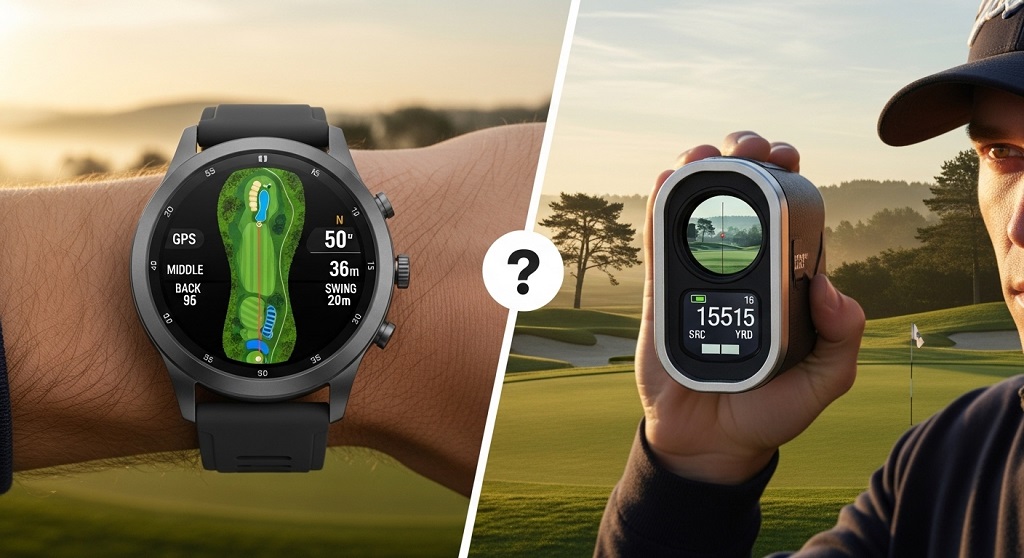
GPS watches typically provide accuracy within 3–5 yards. While rangefinders measure exact flag distance, GPS watches deliver faster access to front, middle, and back green yardages, which improves overall strategy.
Can beginners benefit from golf watches with GPS?
Yes. Beginners benefit significantly because they often struggle with distance estimation. GPS watches simplify club selection and reduce hazard mistakes during early skill development.
Do GPS golf watches track shot distance automatically?
Many advanced models include automatic shot tracking. These watches record club distances, shot locations, and performance patterns, helping golfers improve long-term strategy.
Is slope measurement necessary in GPS golf watches?
Slope measurement helps estimate elevation-adjusted yardage but is not required for effective strategy. Standard front-middle-back distances already provide strong decision support.
How long do golf watch batteries last during a round?
Most GPS golf watches last between 10 and 20 hours in golf mode. That is enough for multiple rounds before recharging.
Can GPS golf watches replace traditional scorecards?
Yes. Many watches include digital scoring features that track strokes, holes played, and performance statistics during the round.
Read More Also: How to Find the Best Cycling Shorts for Men in 2026